
 ·
7 minute read
·
7 minute read
Lead scoring sounds straightforward until you try to actually do it.
B2B lead scoring is the practice of assigning points to contacts based on who they are and what they’ve done, then using those scores to route the highest-priority leads to your sales team.
The concept is simple. Building a model that’s accurate, maintainable and actually used by the people it’s designed to help is not.
I’ve worked through this process with clients across several industries, and the experience has reinforced that the gap between “technically functional” and “genuinely useful” is wider than most people expect at the outset. This post is a practical guide to closing that gap, from designing the model to getting it off the ground.
Why lead scoring matters (and what happens without it)
When every lead looks the same to a sales rep, nothing gets prioritized well. Contacts who filled out a “contact me” form sit in a queue alongside contacts who visited a single web page months ago. A prospect who attended two webinars and downloaded a key resource gets the same response time as someone who landed on the homepage once.
That’s not primarily a sales problem. It’s a data structure problem.
Lead scoring gives your team a shared, systematic answer to the question every rep is implicitly asking: Who should we call first?
And let’s be clear, without lead scoring, prioritization happens anyway — inconsistently, based on gut feel, recency, or whichever contact showed up at the top of the queue. And the sales reps who pushed back on marketing-generated leads in the past? They often had a point. If the leads weren’t differentiated, the skepticism may have been warranted.
Where to start when building your scoring model
Before you set up a single workflow, understand what you’re actually trying to predict. The question isn’t “How do we score leads?” It’s “What does a high-value lead look like for our sales team, and what signals tell us someone is moving toward a buying decision?”
That framing leads to the two-dimensional structure at the heart of most effective scoring models, which separates fit from engagement.
Fit reflects who a contact is, including their role, title, company type, territory and data completeness. A contact who matches your ideal customer profile starts with an advantage, even before they’ve engaged with anything.
Engagement reflects what a contact has done, from the pages they’ve visited to the forms they’ve submitted. It answers not just who someone is, but also how warm they are right now.
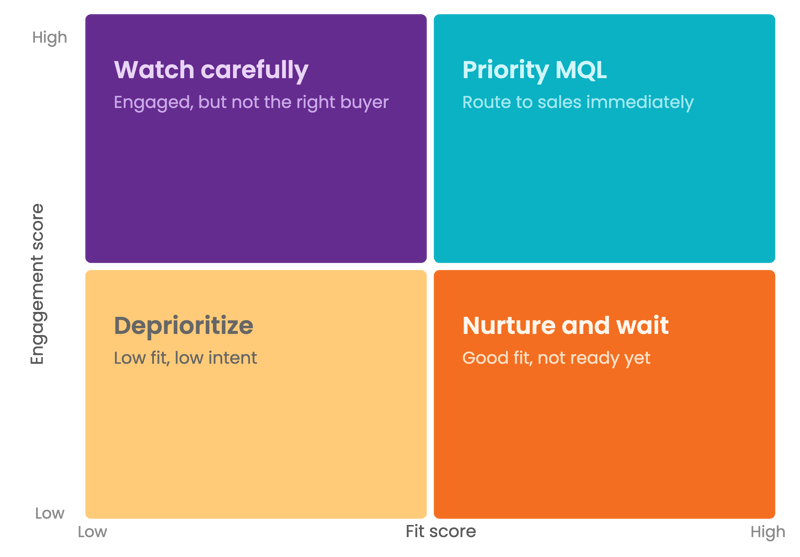
Both dimensions matter, and they should be scored separately. A highly engaged contact with no buying authority is a very different lead than a perfect-fit contact who has never opened an email. Keeping the scores separate lets your team understand why a contact surfaced, not just that it did.
Related Content: Create Your First Marketing Operations Playbook
Building the fit score
Fit scoring draws on firmographic and demographic data, the signals that tell you whether a contact is the kind of person your product is designed for.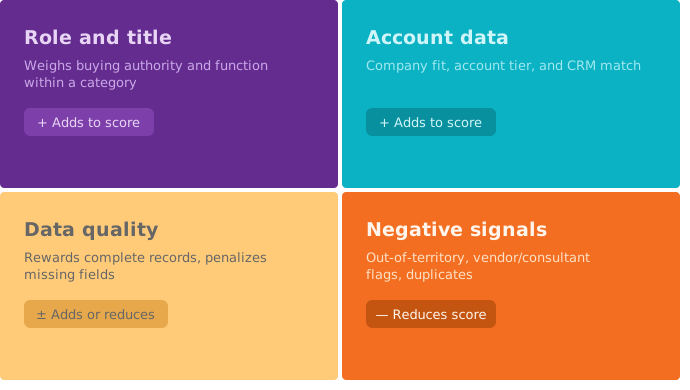 When scoring for fit, particularly in B2B buying scenarios, keep a few things in mind:
Job titles require more nuance than they appear. Within any given professional category, different titles can indicate very different levels of authority, budget access or influence over a purchase decision. A “director” in one function may have far more relevance to your product than a “director” in another. Think through where your scoring needs to make finer distinctions versus broader generalizations.
Account-level data changes the picture. A contact matched to a known account in your CRM carries more weight than one floating without a company association. Whether that company is an existing customer, a strategic target or an unknown prospect is all meaningful input for the fit score.
Negative scoring is part of the model. Not every signal should add points; some should reduce them. Out-of-territory contacts, records flagged as vendors or consultants, and duplicate or suspicious sources should all reduce a score, not just fail to add to it.
Data quality can be a scoring factor, too. If a contact has no job title, no company match, and a free email address, that insight may be worth capturing. After all, a contact you can’t verify is a contact you can’t qualify. Therefore, consider building a component of your score that rewards completeness (e.g., title present, company matched in the CRM, a professional or organizational identifier known) and penalizes records where key fields are missing or where the email domain signals a personal rather than a professional address. Records that appear duplicated or came from low-quality list sources belong in that penalty category, too.
There’s a secondary reason to do this. When data quality affects a contact’s score, this creates a long-term incentive to keep your database clean. Better data produces more accurate scoring, which produces better leads, which gives your sales team more reason to trust the system. The whole thing compounds in the right direction.
Building the engagement score
The complexity of your lead score is likely to grow when it comes to engagement scoring, especially for companies running multiple marketing channels.
Again, a few things to keep in mind:
Not all actions are equal, and some don’t need a threshold. Tier 1 actions like a contact form submission, a demo request or a direct outreach through a third-party channel shouldn’t wait for a contact to accumulate enough points to cross a Marketing Qualified Lead (MQL) threshold. They should trigger immediate qualification, regardless of fit score. Someone who fills out a contact form wants to talk to you. Act accordingly.
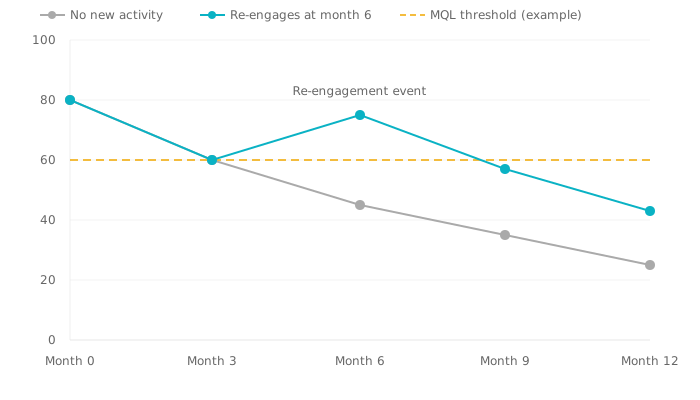
Score decay keeps your model honest. Engagement from 18 months ago shouldn’t carry the same weight as engagement from last month. Building in a decay rate (for example, 25% every 90 days) ensures your model reflects current intent, not a contact’s historical peak. Without decay, your lead list will gradually fill with contacts who were warm once and have since gone cold.
Multiplatform data requires a plan before you build. If your engagement data lives in both HubSpot and Salesforce, or flows in from third-party channels like webinar platforms or event lead retrieval systems, you need a clear architecture for how those scores combine. This is worth mapping out on paper before you touch either platform. Cross-platform lead scoring is technically demanding, and that complexity is much easier to design around upfront than to retrofit later.
When is your lead scoring model ready to launch?
This is the part of the process that tends to get skipped in most guides, but it may be the most practically important.
Many teams get caught in the same loop: They build a scoring model, review it, realize there are edge cases they haven’t accounted for, add more criteria, review again, identify more gaps, and eventually find themselves with a sprawling spreadsheet and a model that has never gone live.
When it comes to implementing lead scoring, don’t let perfection get in the way of good enough. If your model covers the majority of your scoring signals, accurately reflects your sales priorities, and gives reps a meaningful way to differentiate hot leads from cold ones, that’s a perfect starting point — so ship it. And build in a structured review process, typically 60 or 90 days out, to assess how the MQLs are performing and where the model needs refinement. You will learn more from six weeks of live data than from six more weeks of planning.
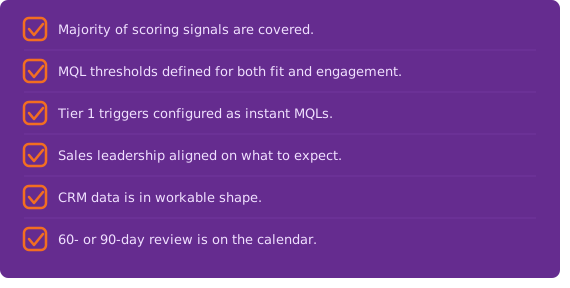
However, one reason not to rush into implementation is messy CRM data. If your database has significant issues (e.g., duplicate contacts, missing key fields, inconsistent lead sources), taking the time to clean house and get your data into workable shape before you build will save you substantial rework on the other side.
Related Content: CRM Data Hygiene: Simple, High-Impact Fixes
How do you get sales reps to actually use your lead scoring model?
Over the years, I’ve learned the hard way that getting the model live is not the same as getting it adopted.
Truthfully, sales rep adoption deserves its own plan. Think about how reps will receive MQL notifications, what they’re expected to do and within what timeframe, and who is responsible for explaining the system to them. What happens when they push back? Because they will.
These aren’t marketing questions in isolation. They require sales leadership to be involved early, and communication should frame the scoring model as something designed to make reps’ work easier, not add another process on top of what they’re already managing. Reps who understand why a lead was prioritized are more likely to act on it. Reps who receive a notification with no context often don’t.
Expect an adoption curve. Even with strong rollout planning, not everyone will use the system correctly right away. That’s normal, and it’s not an indictment of the model. What matters is having a feedback loop so that gaps in adoption get identified and addressed, rather than undermining the system’s value over time.
Related Content: Is It Time to Refresh Your HubSpot Setup?
Lead scoring is never really done
A scoring model that hasn’t been revisited in two years is probably working against you. The signals that predicted buyer intent when you built the model may not be the same ones that predict it now. Your product may have evolved. Your audience may have shifted. Your marketing mix may look completely different.
Building in a regular review cadence, at least annually and after any significant change to your product, audience or campaign strategy, keeps the model aligned with how your business actually operates. It’s also a clear demonstration of marketing’s contribution to pipeline when the model is actively managed rather than set and forgotten.
In other words, lead scoring done well isn’t a project with a finish line. It’s an ongoing system, one that gets more accurate and more useful as you feed it better data and sharper decision rules.
Ready to build a scoring model or improve the one you have?
If you’re not sure whether your current scoring model is doing what it should, or you’ve been putting off building one because the complexity felt daunting, that’s exactly where we start.