
 ·
6 minute read
·
6 minute read

When B2B companies treat trade shows as a sales activity with a marketing relegated to a supporting role, they leave pipeline on the table — and most of them don’t know why.
Once the decision is made to exhibit at a trade show, the planning conversation often starts the same way. Which reps are staffing the booth? What does the demo look like? How many leads does the team need to bring back to justify the investment? These are reasonable questions. But they’re also almost entirely sales questions — and that’s exactly where the problem begins.
In my experience working with B2B marketing teams, marketing does get pulled into the trade show planning eventually. But usually it’s to produce something: a sell sheet, a banner, a follow-up email template. By the time that request lands on your desk, the event is weeks away and the strategic window has already closed. You do what you can with the time you have, and you hope the sales team does something useful with it on the floor.
I’ve watched this play out with clients more than once, and the result is almost always the same: a show that generates activity — badge scans, business cards, a full booth schedule — but very little pipeline. The investment gets made, the team shows up, and then everyone moves on to the next thing. The leads go nowhere, and no one can quite explain why.
The reason isn’t the booth. It isn’t the product. It’s the structure — or more precisely, the absence of one.
What happens when marketing is an afterthought at trade shows?
 Two clients come to mind when I think about this dynamic. In both cases, I learned about an upcoming trade show when the event was nearly upon us. Not because anyone was trying to exclude us — it simply hadn’t occurred to anyone that marketing should be part of the conversation earlier. Sales had booked the booth, arranged travel, and started prepping the team. Marketing was looped in when there was work to be done.
With that kind of runway, our options were limited. Sure, we could produce materials … but we couldn’t build a strategy. And even our ability to produce the right materials was limited; there wasn’t time to develop a pre-show email sequence, or a dedicated landing page, LinkedIn cadence, or the kind of sales enablement tools that would have helped the reps have better conversations on the floor and follow up more effectively afterward.
Yes, the clients generated leads from these shows. But neither generated the pipeline the investments deserved. And in the debrief conversations that followed, the honest answer to “what would have made this more successful” was always some version of the same thing: We needed more time.
What it looks like when you get the structure right
Contrast this experience with another client who has their trade show strategy down to a science. This client consistently generates a large volume of qualified leads at every event, largely because their effort doesn’t start on the show floor – it starts months earlier, when we map their full event calendar together and build a dedicated asset runway for each show, including a landing page, a pre-show email sequence, a LinkedIn cadence, and sales enablement materials the reps have already worked through before they arrive.
By the time the event starts, the marketing engine is already running. In terms of timeline, the show itself is the middle of the campaign, not the whole thing.
At the show, their sales reps also use HubSpot — not just in theory, but in practice. Every conversation at the show gets logged. Every follow-up task gets assigned. Lead quality and rep activity are tracked and tied to performance goals, so the accountability is built into the system rather than left to individual initiative.
A better runway for your trade show marketing strategy
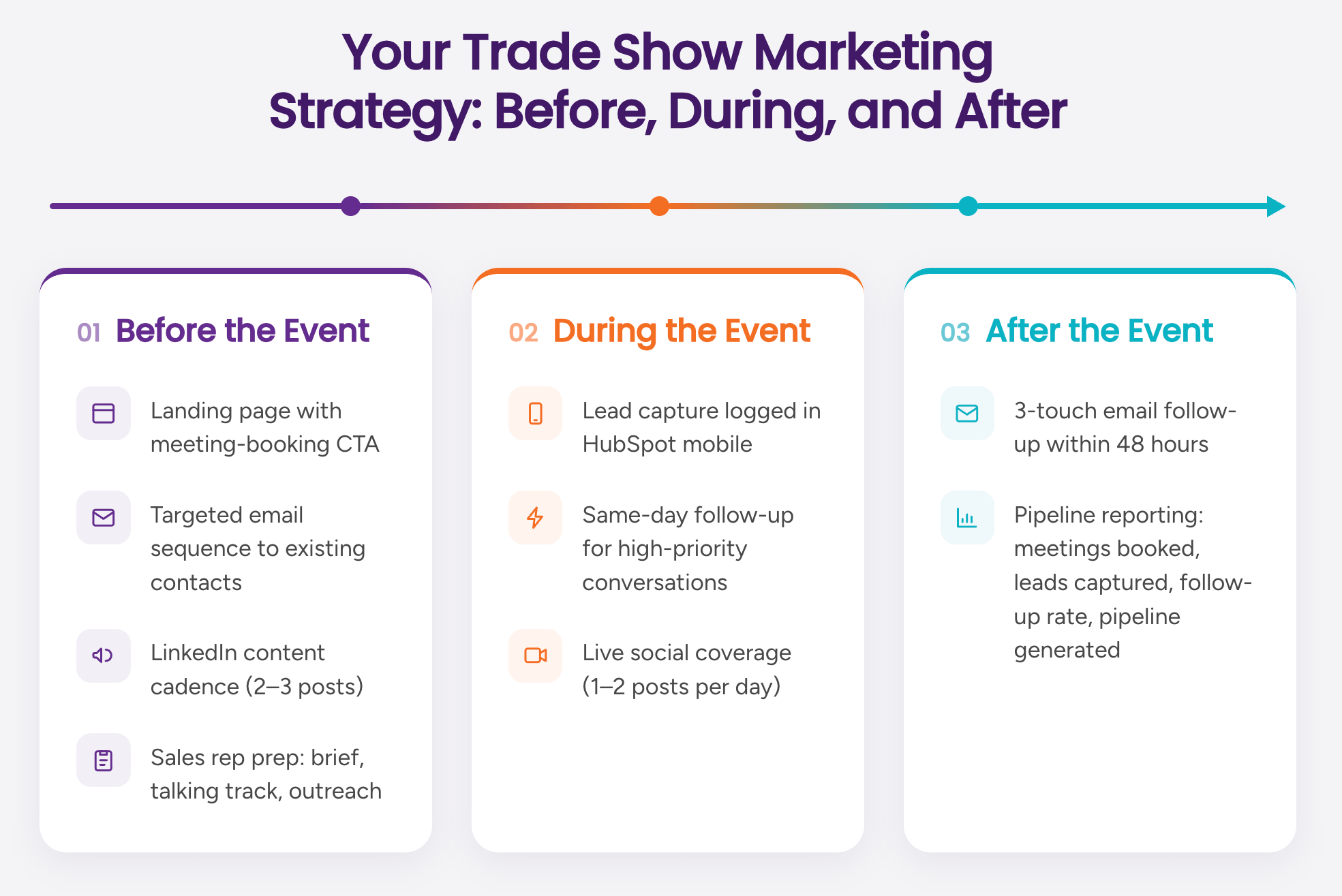
If you’re thinking about applying this approach to your own event calendar, here’s what the asset build looks like across each phase.
Before the event
The goal of the pre-show phase is simple: Generate awareness among the right people and get meetings on the calendar before you ever set foot on the floor. That means a dedicated trade show landing page with your booth number, a clear description of what you’ll be showcasing, and a direct call to action to book a meeting in advance.
It also means a targeted email sequence to your existing contacts — at minimum an announcement and a reminder — focused on securing pre-booked appointments rather than just notifying people you’ll be there.
On LinkedIn, a two to three post cadence in the weeks leading up to the show does meaningful work without requiring a significant time investment: what you’ll be demonstrating, who will be at the booth, why someone attending the conference should make time to find you.
The piece that’s easy to miss is the sales rep preparation. Your reps need more than a booth assignment and a travel itinerary. They need a brief that covers the event audience and your goals, a talking track that connects your product or service to what attendees are likely thinking about, and a pre-show outreach sequence they can run through their own LinkedIn connections and contact lists. Marketing should build all of this. Reps should execute it.
During the event
This phase is less about volume and more about discipline. The most important thing your reps can do on the floor — beyond having good conversations — is capture those conversations in a way that’s actually useful afterward. A badge scan is a name and an email address. What you need is context: what did you discuss, what was the prospect’s level of interest, what did you agree to as a next step.
HubSpot’s mobile app makes this practical in the moment. A rep can log a contact, add a note, and set a follow-up task from the floor without breaking stride. That discipline is what separates a stack of business cards from a structured follow-up pipeline.
Related Content: Onboarding New Sales Reps to HubSpot
On social, a light presence from the show floor — a photo, a quick observation, a session highlight — keeps your audience engaged and signals active participation to the people who didn’t attend. One or two posts per day is enough.
For high-priority conversations, same-day follow-up is worth the effort. A short, personal note sent before the day ends lands differently than a templated email that goes out three days later. Give your reps a template and set the expectation before the show starts.
After the event
This is where trade show ROI is won or lost, and it’s the phase that marketing teams most often leave to chance.
A marketing-owned follow-up sequence — built before the show, deployed within 48 hours of its close — removes the dependency on individual rep initiative. A simple three-touch cadence works: a personal note referencing the conversation, a value-add touchpoint that gives the prospect something useful, and a direct meeting request. The reps should personalize the first touch. Marketing should own the infrastructure that makes sure it actually goes out.
Reporting matters here too. What metrics actually tell the story of a successful trade show? Meetings booked before the event. Leads captured at the show. Follow-up completion rate by rep. Pipeline generated in the 60 to 90 days following the event. Most of this is surfaceable from HubSpot if the team used it correctly during the show — which is another reason the during-event discipline is worth enforcing.
These are the numbers that matter to your C-suite. Having them ready isn’t just good reporting. It’s how you make the case for the next event investment.
Why should marketing lead your trade show strategy?
Everything I’ve described above is executable. None of it is complicated. But it only works if marketing is at the table early enough to build it — and that requires a different conversation than the one most companies are having about trade shows.
If your event calendar is being set by sales or leadership and marketing is notified when it’s time to produce materials, the window for strategic impact closes before it opens. The pre-show email sequence requires list segmentation and copy development. The landing page requires design and development time. The sales enablement materials require collaboration with your reps before they’re standing at a booth. None of that happens in two weeks.
What I’ve seen work is treating the event calendar as a joint marketing and sales planning conversation — ideally at the start of the year, or at minimum 60 to 90 days before each show. Marketing owns the strategy that wraps each event. Sales executes within that structure. Both teams debrief against shared metrics afterward.
That’s not a radical idea. It’s just not how most exhibiting companies operate. And the gap between those two realities is where a lot of trade show investment goes to waste.
The bottom line
Trade shows are expensive. Between the booth fee, the travel, the materials, and the staff time, a single event can represent a meaningful chunk of your marketing and sales budget. Getting a real return on that investment isn’t about spending more — it’s about starting earlier and involving marketing as a strategic partner rather than a production resource.
If you’re heading into event season and your marketing team isn’t already at the planning table, that’s worth a conversation. We’d be glad to help you think through your approach.